How AI Is Transforming Market Intelligence for International Expansion

International expansion has never been simply about entering a new country. It requires companies to understand unfamiliar customers, competitors, regulations, pricing structures, distribution networks, cultural behaviour, and market dynamics—often before they have enough local data to make confident decisions.
Traditionally, market intelligence for international expansion depended on consulting reports, spreadsheets, interviews, trade databases, and months of manual research. These approaches remain valuable, but the volume and speed of information available today have changed the game.
International expansion has never been simply about entering a new country. It requires companies to understand unfamiliar customers, competitors, regulations, pricing structures, distribution networks, cultural behaviour, and market dynamics—often before they have enough local data to make confident decisions.
Traditionally, market intelligence for international expansion depended on consulting reports, spreadsheets, interviews, trade databases, and months of manual research. These approaches remain valuable, but the volume and speed of information available today have changed the game.
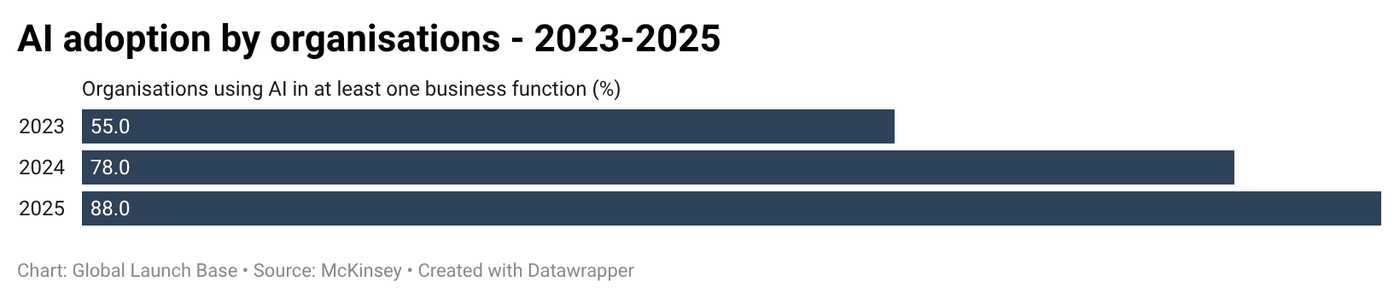
Artificial intelligence is turning market intelligence from a periodic research exercise into a continuous decision-making capability.
For companies expanding internationally, this shift can mean faster market screening, better competitive intelligence, more precise customer segmentation, and earlier identification of market risks.
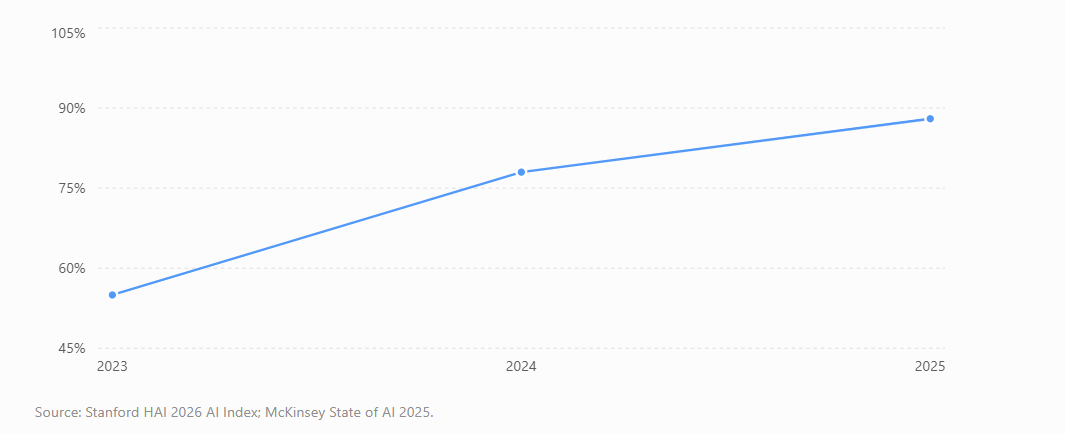
AI adoption across organisations is accelerating
From Static Reports to Dynamic Intelligence
A traditional international market study might answer questions such as:
- How large is the market?
- Who are the major competitors?
- What regulations apply?
- Who are the target customers?
- What is the expected growth rate?
- Which cities or regions should we enter?
The problem is that markets do not remain static while a report is being prepared.
Competitors change their pricing. Governments introduce new regulations. Customer preferences shift. New startups enter the market. Distribution partnerships emerge. Currency movements affect pricing.
AI can continuously process large volumes of information—from company websites and public databases to news, customer reviews, regulatory updates, and industry publications—to identify patterns that human analysts may take much longer to detect.
The result is a move from "What does the market look like?" to "What is changing in the market, and what should we do about it?"
1. AI Makes Market Screening Faster
One of the biggest challenges for companies entering new markets is deciding where to go first.
A company may have 20 potential countries but limited resources to investigate each one deeply.
AI can help create an initial market-screening model based on variables such as:
- Market size
- Market growth
- Customer demand
- Competitive intensity
- Regulatory complexity
- Purchasing power
- Digital adoption
- Import dependency
- Infrastructure readiness
- Partnership availability
- Investment activity
Instead of manually reviewing hundreds of documents for every country, AI can help analysts identify the markets that deserve deeper investigation.
For example, an AgriTech company looking at Europe could compare multiple countries based on agricultural technology adoption, farm structure, climate exposure, policy support, digital infrastructure, and potential customer segments.
AI does not make the final market-entry decision. It helps narrow the decision space.
2. Competitive Intelligence Becomes Continuous
Competitive research traditionally involves creating a competitor list and comparing products, pricing, positioning, funding, partnerships, and customers.
The challenge is maintaining that information.
AI can help monitor changes across multiple competitors and identify signals such as:
- New product launches
- Pricing changes
- New partnerships
- Geographic expansion
- Hiring patterns
- Funding announcements
- Patent activity
- New distribution agreements
- Changes in messaging
- Customer sentiment
This creates a more dynamic competitive intelligence system.
Instead of asking:
"Who are our competitors?"
companies can begin asking:
"Which competitors are changing their strategy, and what does that mean for our entry plan?"
This distinction is particularly important for startups, where competitive positions can change rapidly.
3. Customer Intelligence Goes Beyond Demographics
International expansion often fails because companies assume that a customer problem is identical across countries.
It rarely is.
AI can analyse customer reviews, online discussions, search behaviour, surveys, support tickets, social media conversations, and other available sources to identify recurring needs and pain points.
This can help companies understand:
- What customers complain about
- Which features they value
- What prevents adoption
- How customers describe the problem
- Which alternatives they currently use
- What price points appear acceptable
- What terminology customers use
This last point is particularly useful.
A company may describe its product as "precision agriculture technology," while customers in a target market may search for "farm monitoring," "crop disease detection," or "smart irrigation."
AI can help uncover these language differences.
That insight can influence not only marketing, but also product positioning, sales conversations, and customer discovery.
4. AI Can Identify Market Signals Earlier
International markets generate thousands of signals every day.
Some are obvious:
A new regulation is announced.
Others are subtle:
Several competitors begin hiring sales teams in the same region.
Individually, these signals may not mean much. Together, they can indicate a larger market trend.
AI is particularly useful for identifying relationships between seemingly disconnected signals.
For example:
New regulation → increased compliance requirements → competitors investing in certification → customer concerns about compliance → opportunity for a compliance-focused solution.
This is where AI-powered intelligence becomes strategically valuable.
The objective is not simply to collect more information.
It is to identify signals that could change a business decision.
5. Regulatory Intelligence Becomes More Scalable
Regulation is one of the biggest barriers to international expansion, particularly for sectors such as:
- FinTech
- HealthTech
- AgriTech
- ClimateTech
- Mobility
- Energy
- Food technology
- Industrial technology
Companies need to understand import requirements, certifications, data rules, product standards, environmental regulations, tax structures, procurement requirements, and sector-specific legislation.
AI can help classify and summarise large volumes of regulatory information and highlight changes that require human review.
For example, an international expansion team could build a monitoring system around:
Country → Regulation → Product impact → Compliance requirement → Responsible team → Deadline
This can reduce the amount of manual monitoring required.
However, regulatory intelligence is an area where human validation remains critical. AI-generated interpretations should not automatically be treated as legal advice.
6. AI Improves Partner Identification
Entering a new country often requires local partners.
These might include:
- Distributors
- System integrators
- Technology partners
- Research institutions
- Government agencies
- Industry associations
- Local sales representatives
- Investors
- Pilot customers
Finding potential partners is relatively easy.
Finding the right partners is much harder.
AI can help companies screen potential partners based on criteria such as:
- Geographic coverage
- Industry expertise
- Existing customers
- Product compatibility
- Company size
- Strategic relationships
- Technology capabilities
- Previous international partnerships
This can turn partner research from a long list of names into a structured prioritisation exercise.
7. AI Can Support Localisation
International expansion is not simply about translating a website.
A product may need to be adapted to local:
- Pricing
- Regulations
- Customer behaviour
- Distribution models
- Payment systems
- Sales cycles
- Business practices
- Language
- Cultural expectations
AI can analyse market-specific information and help identify where localisation is required.
For example, the same AgriTech product might need completely different positioning in the Netherlands, India, and Brazil because the farm structure, purchasing behaviour, technology adoption, and distribution ecosystems differ.
AI helps companies identify these differences before investing heavily in the market.
8. AI Changes the Role of the Market Intelligence Team
AI does not necessarily eliminate market research teams.
It changes what they spend their time doing.
Traditional model
Research → Collect → Clean → Analyse → Report
AI-enabled model
Monitor → Detect → Validate → Interpret → Decide → Act
The difference is significant.
Analysts can spend less time collecting repetitive information and more time asking strategic questions:
- Why is this market changing?
- Which customer segment is most attractive?
- Which competitor represents the biggest threat?
- Which partnership could accelerate entry?
- What assumption in our market-entry strategy is weakest?
- What evidence would change our decision?
This moves market intelligence closer to the centre of strategic decision-making.
The AI-Powered International Expansion Stack
A practical AI-enabled market intelligence system can be structured into five layers:
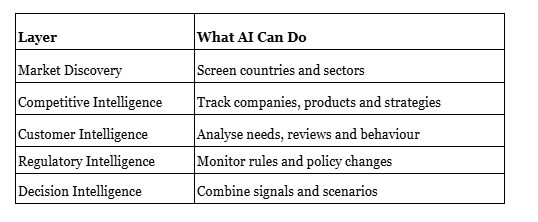
The key is connecting these layers.
A company should not have one AI tool for competitor research, another for customer research, and another for regulatory monitoring without a common decision framework.
The intelligence becomes valuable when the information connects.
But AI Has a Major Limitation
AI can process information quickly.
That does not mean it automatically understands the market correctly.
There are several risks.
Hallucinated information
AI systems can generate plausible but incorrect facts, company details, statistics, or citations.
Outdated information
A market report from two years ago may no longer reflect current conditions.
Data bias
Online information is not necessarily representative of the entire customer population.
Context failure
AI may correctly identify a fact but misunderstand its commercial significance.
False confidence
A beautifully structured AI-generated report can create the illusion of certainty.
For international expansion, this is dangerous.
AI should accelerate research—not replace verification.
Critical information should be validated against reliable primary or authoritative sources, particularly for regulations, market sizes, pricing, company information, and investment decisions.
The Human + AI Advantage
The most effective international expansion teams will probably not be those that use the most AI tools.
They will be the teams that combine AI speed with human judgement.
AI is excellent at:
- Processing large datasets
- Finding patterns
- Monitoring changes
- Summarising information
- Comparing markets
- Generating hypotheses
- Identifying potential signals
Humans remain essential for:
- Building relationships
- Conducting customer interviews
- Understanding cultural context
- Validating assumptions
- Interpreting ambiguous signals
- Negotiating partnerships
- Making strategic trade-offs
The winning model is therefore not AI versus analysts.
It is AI + analysts + local market knowledge.
From Market Research to Market Readiness
The ultimate purpose of market intelligence is not to produce a report.
It is to answer a more important question:
Is the company ready to enter this market?
A strong AI-enabled market intelligence framework should therefore connect research directly to an expansion decision.
For each target market, companies can score:
Market Attractiveness × Product Fit × Competitive Position × Regulatory Readiness × Partner Readiness × Execution Capability
This creates a more practical view of internationalisation.
A large market is not necessarily a good market.
A smaller market with strong product-market fit, accessible customers, supportive regulations, and an effective local partner may provide a much better entry opportunity.
What This Means for European Startups
For European startups, AI-powered market intelligence could become particularly important as they expand beyond their home markets.
Many startups have strong technology but limited resources for international research.
Instead of spending months building large research reports for every country, startups can use AI to create a market intelligence funnel:
10–20 markets → AI screening → 5 priority markets → deeper research → local validation → pilot market → expansion
This allows limited teams to focus their time and budget where the evidence is strongest.
But the final stage remains human.
Before committing significant resources, startups should speak to local customers, partners, distributors, experts, and ecosystem stakeholders.
AI can tell you where to look. Local validation tells you whether you are right.
The Future: Market Intelligence as a Continuous Capability
The biggest transformation may not be the introduction of AI itself.
It is the change from one-time market research to continuous market intelligence.
Companies entering a market should not conduct research once and then put the report away.
They should continuously monitor:
- Customer demand
- Competitor activity
- Regulation
- Pricing
- Partnerships
- Funding
- Technology trends
- Economic conditions
- Market sentiment
AI makes this continuous approach increasingly practical.
The international expansion team of the future may therefore operate less like a research department and more like an early-warning and decision-support system.
Conclusion
International expansion has always been an information problem.
Companies need to make high-stakes decisions despite incomplete knowledge of customers, competitors, regulations, and market dynamics.
AI does not remove that uncertainty.
But it can dramatically improve how companies find, organise, analyse, and act on information.
The companies that gain the greatest advantage will not simply ask AI to generate market reports.
They will build AI into the entire expansion process—from market screening and competitive intelligence to customer discovery, partner identification, regulatory monitoring, and decision-making.
The future of international expansion is therefore not just faster market research.
It is continuous, evidence-driven market intelligence that helps companies know where to go, when to enter, and how to win.
For internationalising startups, that could become one of the most important competitive advantages of the AI era.
Global Launch Base helps international startups expand in India. Our services include market research, validation through surveys, developing a network, building partnerships, fundraising and strategy revenue growth. Get in touch to learn more about us.
"AI-Generated Content Disclaimer: This content was generated in part with the assistance of artificial intelligence tools. While efforts have been made to review, edit, and ensure accuracy, completeness, and reliability, the content may contain errors or omissions. It should not be considered professional advice, and users should independently verify any information before making decisions based on it. The publisher/author assumes no responsibility or liability for any consequences resulting from reliance on this content.".