Localization vs. Standardization_ Finding the Right Balance When Launching Globally
Over 72% of global consumers say they are more likely to buy from a brand that communicates in their local language, and companies that localize their experience see up to 40% higher revenue growth compared to those that don’t. At the same time, standardized global brands benefit from 30–50% lower operational costs due to centralized production, branding, and marketing systems.
In 2024 alone:
- Global cross-border e-commerce crossed USD 6.3 trillion
- More than 65% of companies planned international expansion into at least one new region
- Yet, 44% of global product launches failed due to poor market adaptation, pricing mismatch, or cultural disconnect
These numbers reveal one clear truth:
Global success is no longer about choosing between localization or standardization—it’s about mastering the balance between both.
As companies scale across borders, they face a strategic dilemma:
Should they maintain a uniform global identity for speed and cost efficiency? Or adapt deeply to win trust in each local market?
The answer lies in a hybrid strategy—one that blends global consistency with local relevance.
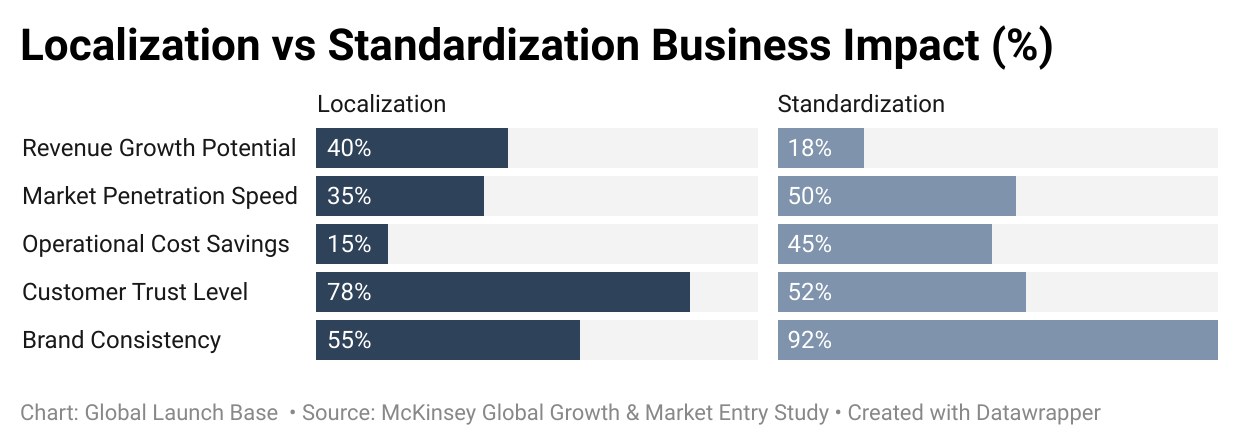
Why This Balance Matters
Global markets are increasingly interconnected, yet deeply different. What works in Europe may not work in India. A campaign that thrives in the U.S. may fall flat in Japan. Launch strategies must therefore evolve from “copy-paste” models to market-sensitive frameworks.
A balanced approach ensures:
- Brand consistency worldwide
- Local cultural fit
- Optimized marketing spend
- Better customer adoption and loyalty
1. What is Standardization?
Standardization means keeping core elements the same across markets.
It focuses on efficiency, consistency, and speed.
Standardized Elements Usually Include:
- Brand identity (logo, colors, voice)
- Core product features
- Company values
- Global pricing philosophy
- Universal messaging themes
Benefits of Standardization
- Lower operational costs
- Faster market rollouts
- Strong, unified brand image
- Simplified supply chain
- Avoids fragmentation of product versions
Where Standardization Works Best
- Tech products with universal use cases
- Markets with similar consumer behavior
- B2B segments where functionality matters more than local culture
2. What is Localization?
Localization means adapting the product and marketing strategy to the needs of each market.
Localized Elements Usually Include:
- Language and tone of campaigns
- Pricing based on local purchasing power
- Product sizing, flavors, or features
- Payment methods
- Regulatory compliance
- Cultural communication styles
Benefits of Localization
- Stronger customer connection
- Higher acceptance and faster adoption
- More effective marketing influence
- Competitive advantage over non-localized offerings
Where Localization Works Best
- Culturally sensitive markets (Japan, Middle East)
- Consumer-driven categories (food, fashion, retail)
- Countries with high price sensitivity (India, Southeast Asia)
By late 2025, major global supply chains have undergone significant transformation:
- Nearshoring and friend-shoring continue to rise, especially in electronics, EVs, textiles, pharmaceuticals, and food processing.
- Companies are diversifying suppliers to avoid single-country risk.
- New logistics routes are emerging because of conflicts, trade restrictions, and port congestion.
These shifts directly influence launch timelines, sourcing decisions, and cost structures.
. Supply Chain & Trade Realignment in 2025
- 67% of global companies adopted nearshoring/friend-shoring between 2023–2025.
- Asia–Pacific contributes 42% of global manufacturing output.
- Shipping route changes increased average freight costs by 18–22%.
- Cross-border e-commerce reached $6.3 trillion (UNCTAD 2025).
Regional Trade Blocs Shape Market Access
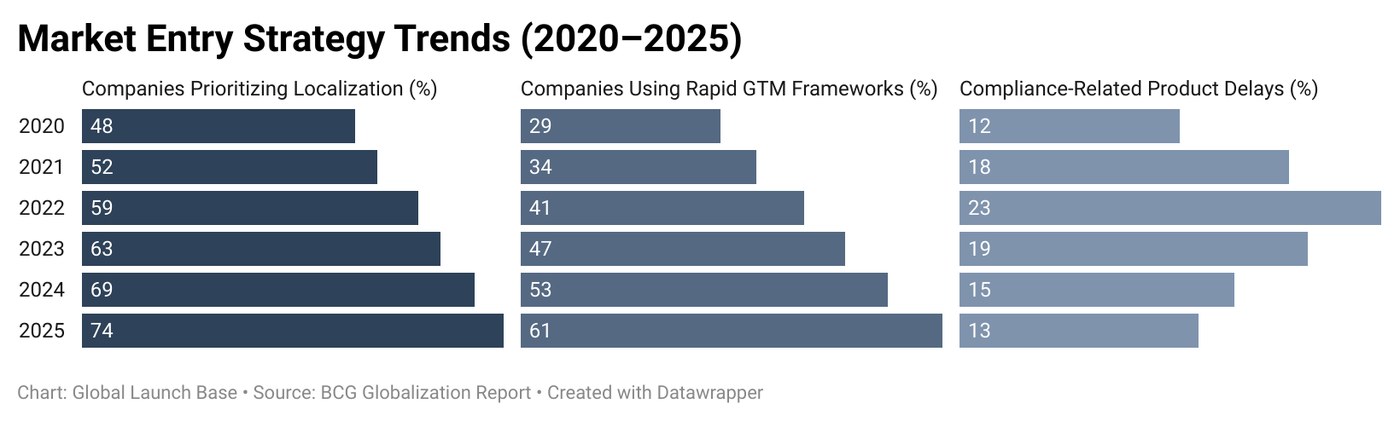
Year-end 2025 shows stronger trade regionalization:
- RCEP drives integration across Asia–Pacific.
- AfCFTA attracts FMCG, agri-tech, and textile companies entering African markets.
- The EU tightens regulatory frameworks, especially around climate reporting and digital compliance.
- North America continues to integrate supply chains for batteries, EVs, and critical minerals.
Understanding these blocs is now essential for selecting launch targets.
Trade Bloc Influence
- RCEP now covers 30% of global GDP and cut tariffs on 92%+ of goods.
- AfCFTA may increase intra-African trade by 52% by 2030; 46 countries operational.
- EU digital and sustainability rules affect 80%+ of global tech and consumer-product entrants.
Regulations Have Tightened Across Industries
By end of 2025:
- 160+ countries strengthened data privacy regulations by 2025.
- 31+ countries introduced formal AI governance frameworks.
- ESG reporting requirements cover over 90% of global market capitalization.
- Sustainability compliance adds 8–12% extra cost in FMCG, food, and apparel sectors.
Compliance now determines how quickly a company can enter a market.
Consumer Behavior
- 65% of global consumers are now digital-first.
- 58% check compliance, sustainability, and product-origin information before purchase.
- Cross-border online shopping increased 19% YoY in 2025.
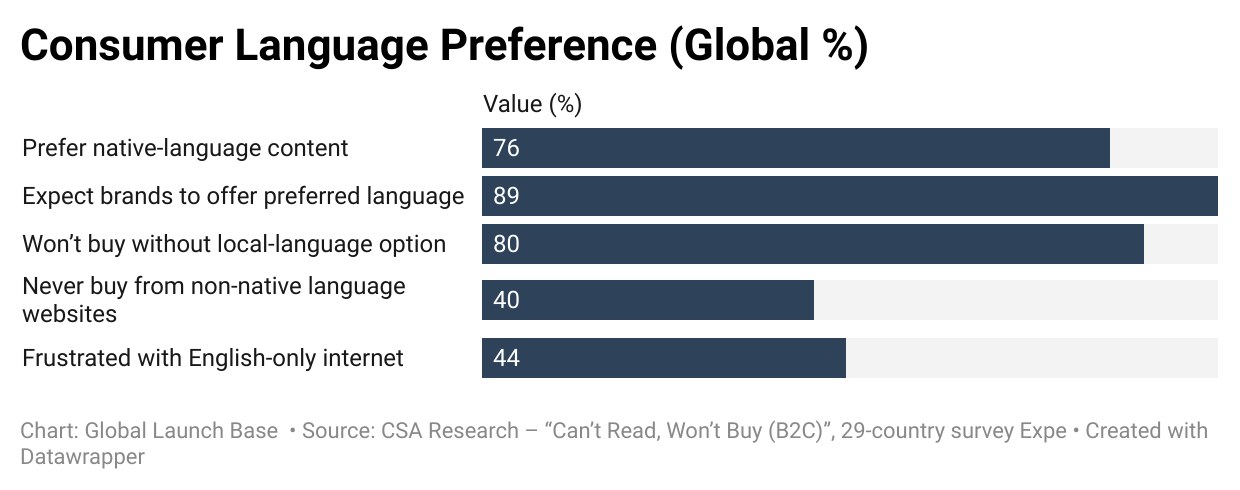
Market-Entry & Launch Trends
- Companies spent $2.1 trillion on global expansion in 2025.
- 1 in 4 product launches now includes multi-country rollout from day one.
- 36–40% of global product launches fail due to compliance & localization mistakes.
2. How Market Entry Strategy Must Evolve in Late 2025
2.1 Agility Over Traditional Linear Planning
The old model—research → build → launch—has become too slow.
Modern market-entry strategies in 2025 must:
- Rapidly adjust product features and pricing
- Pivot market priority based on trade or regulatory changes
- Integrate continuous compliance monitoring
- Make real-time decisions on logistics and distribution
Agility has become a launch accelerator.
2.2 Localization Is Deeper and More Strategic
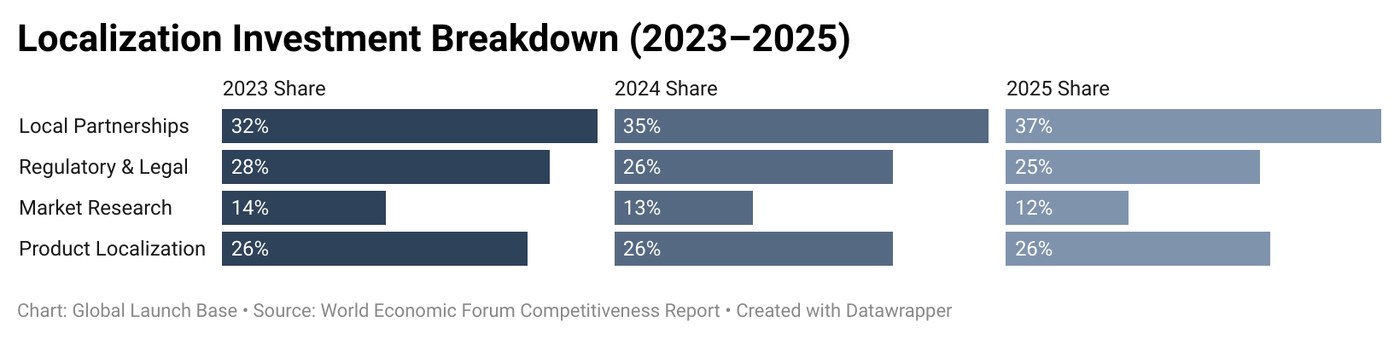
Localization in 2025 includes far more than language adaptation:
- Customized product features
- Region-specific packaging and formats
- Cultural adaptation in marketing & UX
- Local distribution partnerships
- Country-specific certifications and labeling
Consumers now expect brands to feel local, not global.
2.3 Compliance-First Market Entry
By the end of 2025, compliance sits at the center of market-entry planning.
Companies must prepare for:
- Digital privacy rules
- Import/customs regulations
- Certification pathways
- ESG and climate reporting requirements
- AI transparency and model-use rules
- Country-specific consumer protection norms
Fast compliance = fast market entry.
2.4 Structured, Repeatable Go-To-Market Frameworks
With rising complexity, companies are turning to structured launch frameworks:
- Standard operating procedures for each market
- Templates for partner onboarding
- Pre-approved regulatory checklists
- Automation for documentation and compliance
- Country-specific playbooks
- Cross-functional communication dashboards
Speed + structure is the new formula for global expansion.
5. Practical Framework for Global Launch Teams
Global Standardization Checklist
- Brand guidelines
- Core features
- Product naming
- Quality standards
- Launch timeline and messaging themes
Localization Checklist
- Market-specific pricing
- Language and cultural adaptation
- Partnerships and local channels
- Regulatory approvals
- Local influencers or retailers
6. Benefits of Getting the Balance Right
A well-balanced strategy delivers:
- 20–40% lower marketing costs
- 30–50% faster market penetration
- Higher brand recall
- Better conversion rates
- Stronger long-term loyalty
Companies that mix both approaches generally outperform those that choose only one.
7. Conclusion
Successful global launches are not just about expanding overseas—they’re about expanding smartly. Standardization gives speed and consistency, while localization creates relevance and trust.
The right question is not which strategy to choose but how much of each to use.
Brands that master this balance build stronger global identities while winning the hearts of local customers.