Public-Private Partnerships in Agriculture_ Lessons from Global Models
Introduction
Agriculture today sits at the intersection of food security, climate resilience, and economic growth. However, governments alone often lack the capital, technology, and operational efficiency needed to modernize the sector at scale. This is where Public-Private Partnerships (PPPs) emerge as a strategic solution—bringing together policy support from the public sector and innovation, investment, and efficiency from private players.
Across the world, PPPs in agriculture have demonstrated measurable impact in improving productivity, strengthening value chains, and enabling market access for farmers. By examining global models, developing economies like India can design more effective and scalable agricultural partnerships.
What are PPPs in Agriculture?
Public-Private Partnerships in agriculture refer to collaborative arrangements between government bodies, private companies, NGOs, and sometimes farmer organizations. These partnerships typically focus on:
- Infrastructure development (irrigation, storage, logistics)
- Technology adoption (precision farming, digital platforms)
- Input supply chains (seeds, fertilizers, mechanization)
- Market linkages and export promotion
The core objective is risk-sharing while leveraging complementary strengths.
Global Models and Key Lessons
1. The Netherlands: High-Tech Agriculture Ecosystem
The Netherlands has built one of the most advanced agricultural systems despite limited land availability. PPPs here are deeply integrated into research and innovation.
- Collaboration between government, universities, and private firms
- Strong role of Wageningen University & Research
- Focus on greenhouse farming, precision agriculture, and agri-tech startups
Lesson:
Investing in R&D-driven PPPs can significantly increase productivity and resource efficiency.
2. Brazil: Embrapa Model
In Brazil, the government established Embrapa, which works closely with private agribusinesses.
- Development of region-specific crop varieties
- Public research translated into commercial applications
- Strong extension services connecting farmers to innovation
Lesson:
Public research institutions can act as bridges between science and scalable private-sector adoption.
3. Kenya: Contract Farming & Market Linkages
Kenya has successfully used PPPs in horticulture and dairy sectors.
- Partnerships between exporters and smallholder farmers
- Government support in quality standards and certifications
- Private investment in cold chains and logistics
Lesson:
PPPs can enable small farmers to integrate into global value chains through structured market access.
4. United States: Agri-Infrastructure & Insurance
In the United States, PPPs focus heavily on risk management and infrastructure.
- Federal crop insurance programs implemented with private insurers
- Partnerships in irrigation, storage, and transportation
- Strong role of agri-tech companies in digital farming
Lesson:
Risk-sharing mechanisms (like insurance) are critical for encouraging private investment in agriculture.
5. India: Emerging PPP Models
India is gradually expanding PPPs in agriculture through multiple initiatives:
- e-NAM (digital agricultural marketplace)
- Mega Food Parks scheme
- Collaboration with agri-tech startups for farm advisory
Private players like ITC Limited (e-Choupal model) have demonstrated how digital platforms can empower farmers.
Lesson:
Digital infrastructure and localized models are key to scaling PPPs in diverse agricultural landscapes.
Key Data & Insights on PPPs in Agriculture
1. Agriculture & Investment Gap
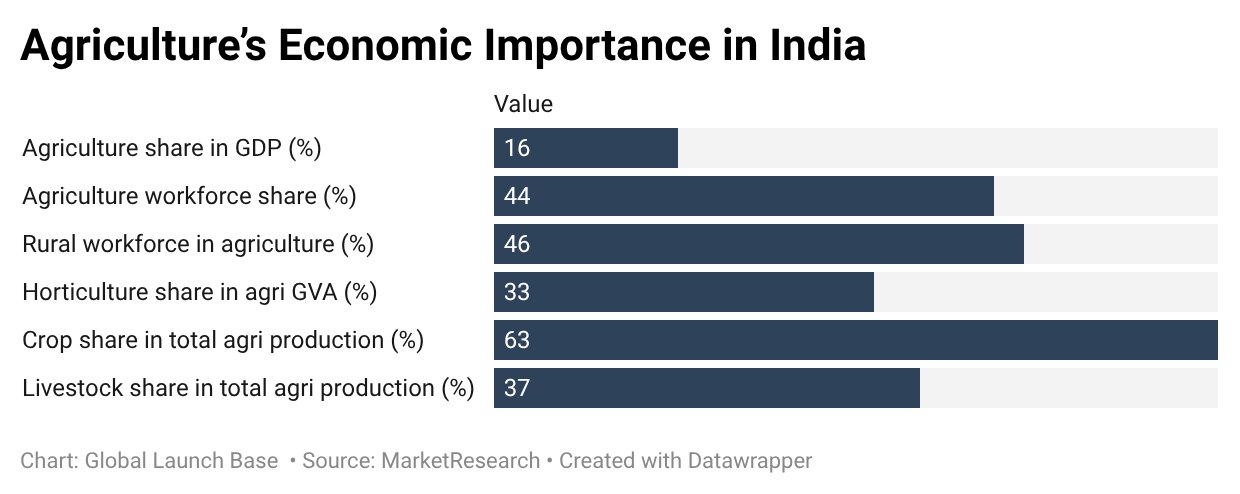
- Agriculture contributes ~16% of GDP in India and employs nearly 50% of the workforce
- In many developing countries, over 50% of the population depends on agriculture
- Public investment alone is insufficient, creating a strong need for PPP-based financing models
Insight: PPPs are critical because agriculture is a high-impact but underfunded sector.
2. Impact of PPPs on Productivity
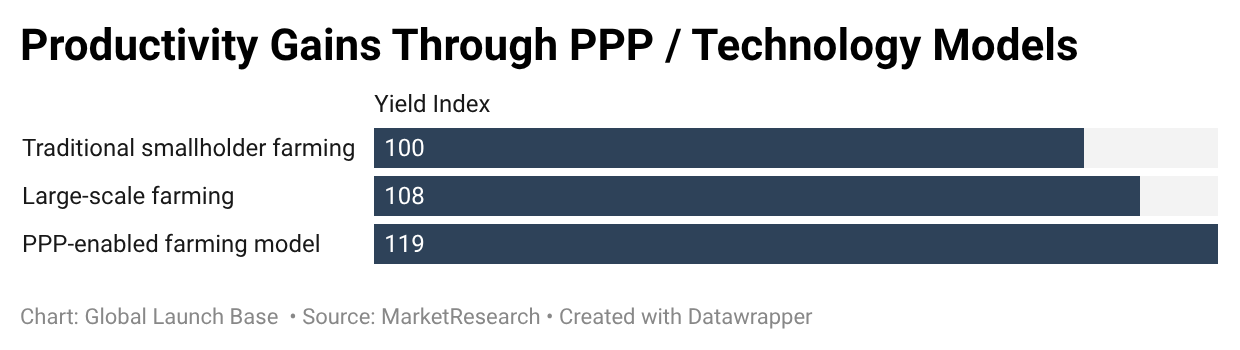
- PPP-based farming models have shown measurable yield improvements:
- Example (China case study):
- +11.8% higher yield vs large-scale farming
- +19.4% higher yield vs smallholder farming
- Example (China case study):
Insight: PPPs improve technology adoption and operational efficiency, leading to higher productivity.
3. Economic & Social Impact
PPPs in agriculture contribute to:
- Increased farmer access to markets
- Improved access to modern technology
- Higher income generation
- Employment creation
- Poverty reduction
- Strengthened food security
Insight: PPPs play a direct role in improving rural livelihoods, not just economic output.
4. Role in Technology & Innovation
PPPs enable:
- Deployment of advanced farming technologies
- Expansion of digital advisory systems
- Access to market intelligence platforms
They also accelerate:
- Technology transfer from research institutions to farms
- Adoption of precision agriculture and agri-tech solutions
Insight: PPPs bridge the gap between innovation and on-ground implementation.
5. Sustainability & Climate Impact
- PPP-led models improve:
- Resource efficiency
- Energy use in agriculture
- Environmental sustainability
- They also contribute to:
- Reduced carbon footprint
- Climate-resilient farming practices
Insight: PPPs are essential for scaling climate-smart agriculture.
6. Structural Advantages of PPPs
PPPs combine:
- Public sector strengths: policy support, regulation, inclusivity
- Private sector strengths: capital, efficiency, innovation
This results in:
- Better risk-sharing
- Faster project execution
- Improved return on investment
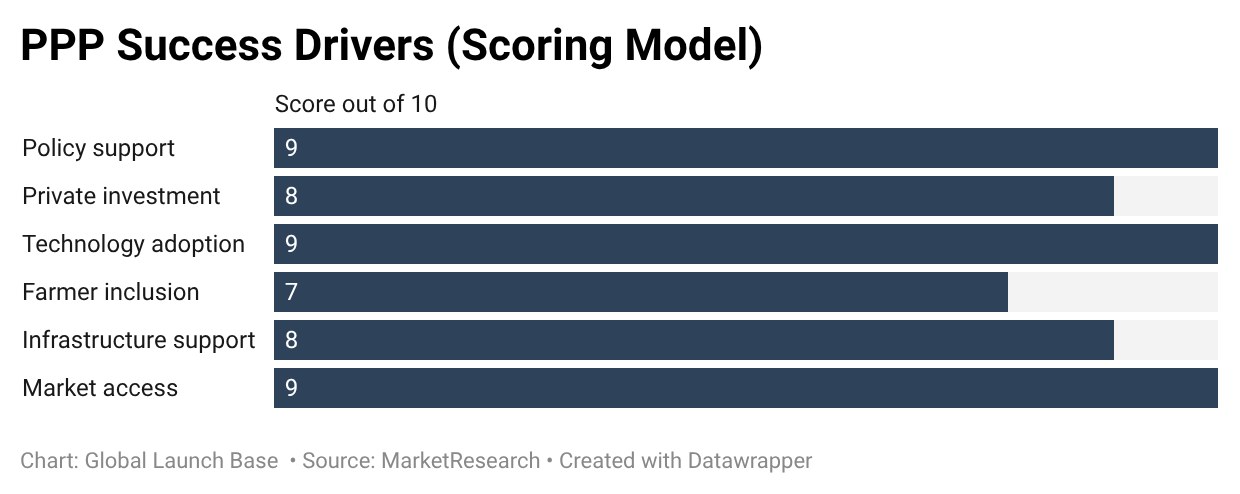
Key Success Factors Across Models
Factor | Description | Impact |
|---|---|---|
Policy Stability | Long-term government commitment | Encourages private investment |
Clear Roles | Defined responsibilities for partners | Reduces conflicts |
Farmer Inclusion | Direct engagement with farmers | Ensures adoption and impact |
Technology Integration | Use of data, AI, IoT | Improves efficiency |
Financial Viability | Sustainable revenue models | Ensures longevity |
Strategic Opportunities for India
India has strong potential to scale PPPs in agriculture, especially in:
- Agri-logistics: Warehousing, cold chains, and rural transport
- Climate-smart agriculture: Water management, carbon farming
- Farm digitization: AI-based advisory, satellite monitoring
- Value addition: Food processing and export-oriented clusters
Regions like Karnataka, with active agri-innovation ecosystems, can serve as pilot hubs for PPP-led transformation.
Conclusion
Public-Private Partnerships are not just funding mechanisms—they are enablers of systemic transformation in agriculture. Global experiences show that when governments provide the right policy environment and private players bring innovation and efficiency, agriculture can evolve into a resilient, technology-driven, and market-oriented sector.
For India, the next step is not just adopting PPPs, but designing them with local realities in mind—ensuring that farmers remain at the center of every partnership.