What 8_ Adoption Looks Like_ A Reality Check for European AgriTech Pilots in India
What 8% Adoption Looks Like: A Reality Check for European AgriTech Pilots in India
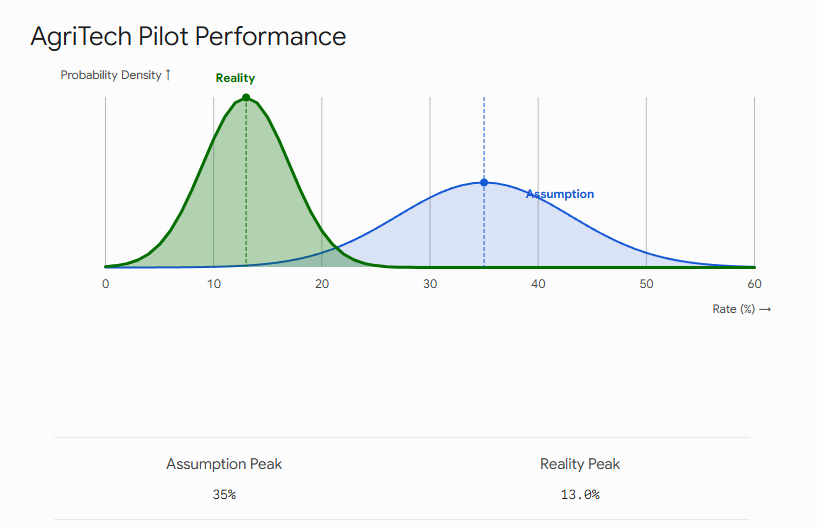
European AgriTech founders entering the Indian market routinely make a foundational error: they mistake initial interest for scalable adoption. In pitch decks mapping out expansion into South Asia, it is common to see projected adoption rates of 30% to 40% among target farmer groups.
Then, the first pilot season happens.
Data from Indian AgriTech pilots—including case studies from the EU SME Centre, ICAR adoption-rate research, and field data from the Aré Guḍi pilot site—reveal a starkly different reality. In practice, actual, sustained technology adoption regularly collapses to 8% to 15%.
This discrepancy is not a failure of the technology itself. It is a failure to understand the friction inherent in Indian rural distribution networks and smallholder economics.
The Assumption vs. Reality Gap
The core friction of entering the Indian agricultural market lies in the sudden shift from theoretical value to operational reality. To visualize what happens to a startup’s metrics over a single pilot season, consider the shift in two critical variables: Adoption Rate and Willingness-to-Pay (WTP).

Why the Collapse Occurs: Structural Friction
Startup India and NABARD research into AgriTech failures consistently points to three structural barriers that European founders routinely underestimate.
1. The Extension-Service Deficit
In mature Western markets, technology deployment relies heavily on digital literacy and established commercial extension services. In India, the institutional bridge—primarily the ICAR-Krishi Vigyan Kendras (KVKs) and state extension networks—is stretched thin. According to NABARD FPO (Farmer Producer Organization) studies, tech deployment requires intense, localized, human-in-the-loop intervention. Without it, the "last-mile" drop-off is immediate.
2. High-Friction Rural Distribution
As economists Hoch and Banerjee highlight in their research on Indian rural distribution, rural retail networks are highly fragmented and built entirely on deeply entrenched trust corridors. A European SME cannot simply digitize its way into this ecosystem. If your product requires a physical supply chain or hardware maintenance, your distribution model faces immediate logistical gridlock.
3. The "Willingness-to-Pay" Mirage
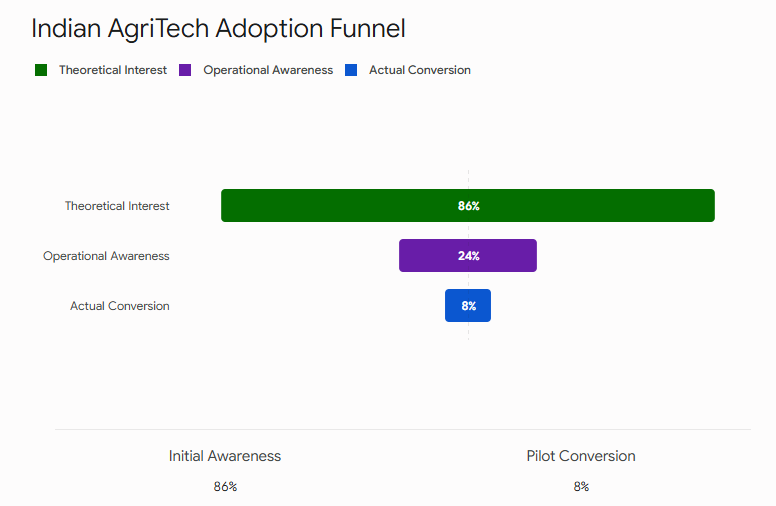
During initial discovery phases, farmers often express high interest in optimization tools. However, when a pilot demands an upfront financial commitment or a shift away from subsidized traditional inputs, the demand curve contracts sharply.
Data from the Aré Guḍi pilot reflects this exact pattern:
- Pre-pilot engagement: High verbal alignment and strong attendance at product demonstrations.
- Post-pilot conversion: A sharp narrowing of active users to a core 8%, driven by hyper-localized risk aversion and immediate cash-flow constraints.
The Structural Reality: In an ecosystem dominated by smallholder farms, technology is rarely evaluated on long-term ROI. It is evaluated on immediate, seasonal risk mitigation. If a tool requires capital upfront but only yields returns at harvest, the financial friction kills adoption before the season ends.
Bridging the Gap: The Blueprint for Adoption
The 8% baseline is not a permanent ceiling; it is a design constraint. Foreign startups can bridge this gap and drive scale by re-engineering their deployment strategies around three localized solutions:
De-Risk via "Pay-As-You-Go" & Credit Integration
To counter the "Willingness-to-Pay" mirage, successful pilots avoid large upfront capital requirements. Startups should shift to fractional software-as-a-service (SaaS) or pay-per-use hardware rentals aligned directly with the crop cycle cash flows. Furthermore, embedding your technology into existing agri-fintech frameworks allows farmers to leverage institutional credit to finance the tech, shifting the cost from a risky capital expense to an affordable operating expense.
Anchor Within the FPO Leadership Cocoon
Instead of trying to educate 400 separate smallholders individually, focus deployment entirely on the FPO's board of directors and local progressive "lead farmers." Field evidence indicates that when an FPO’s leadership visibly anchors a technology on their own plots, the trust barrier dissolves. The local community watches the yield improvement, moving the remaining 92% of farmers from skepticism to adoption through peer-to-peer validation.
Leverage the Existing "Phygital" Infrastructure
Do not attempt to build a standalone digital supply chain. Instead, piggyback on the deeply entrenched networks of local rural input retailers and state-backed KVK extension workers. By offering these local entities commissions, training, or data dashboards, you transform them into your last-mile distribution and tech-support network.
The Structural Reality: In an ecosystem where the vast majority of holdings are smallholder farms, technology is rarely evaluated on long-term ROI. It is evaluated on immediate, seasonal risk mitigation. By offering flexible pricing, local trust anchors, and clear risk mitigation, startups can systematically dismantle these economic walls.
The Strategic Takeaway: The 8% Moat
The transition from a 40% theoretical adoption model to an 8% reality is fatal for startups that burn capital scaling up prematurely. This data underscores exactly why executing a rigorous, localized pilot is an absolute prerequisite before committing growth capital to the Indian market.
A single pilot season does not ruin your business model—it calibrates it. It forces founders to adjust pricing structures, redesign deployment pipelines around FPOs, and build realistic unit economics based on actual market behavior rather than optimistic projections.
Crucially, this reality check carries a powerful upside. While an 8% conversion rate looks modest on paper, those 8% are your hyper-sticky, highly resilient early adopters. In a market as vast as India, converting a disciplined 8% of a target region yields a massive, highly loyal user base that has survived the ultimate stress test. By designing for the friction up front and deploying localized operational solutions, founders can turn a localized pilot into an unassailable operational moat—capturing a market that less-prepared competitors will simply burn out trying to reach.