Why European AgriTech Startups Are Looking to India for Their Next Growth Market
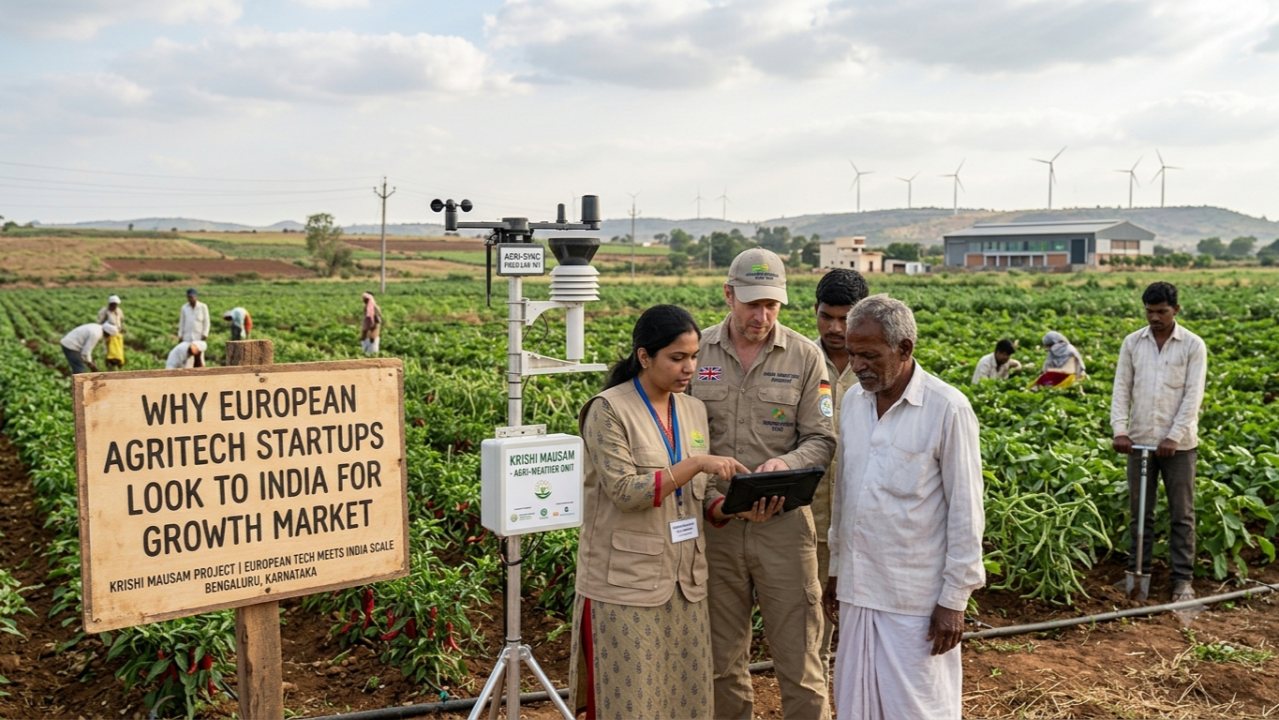
For European AgriTech startups, the next growth opportunity may not be another European market. It may be India.
India is moving rapidly from being simply one of the world's largest agricultural economies to becoming a testing ground for digital agriculture, climate resilience, precision farming, AI, farm mechanisation, and new agricultural business models.
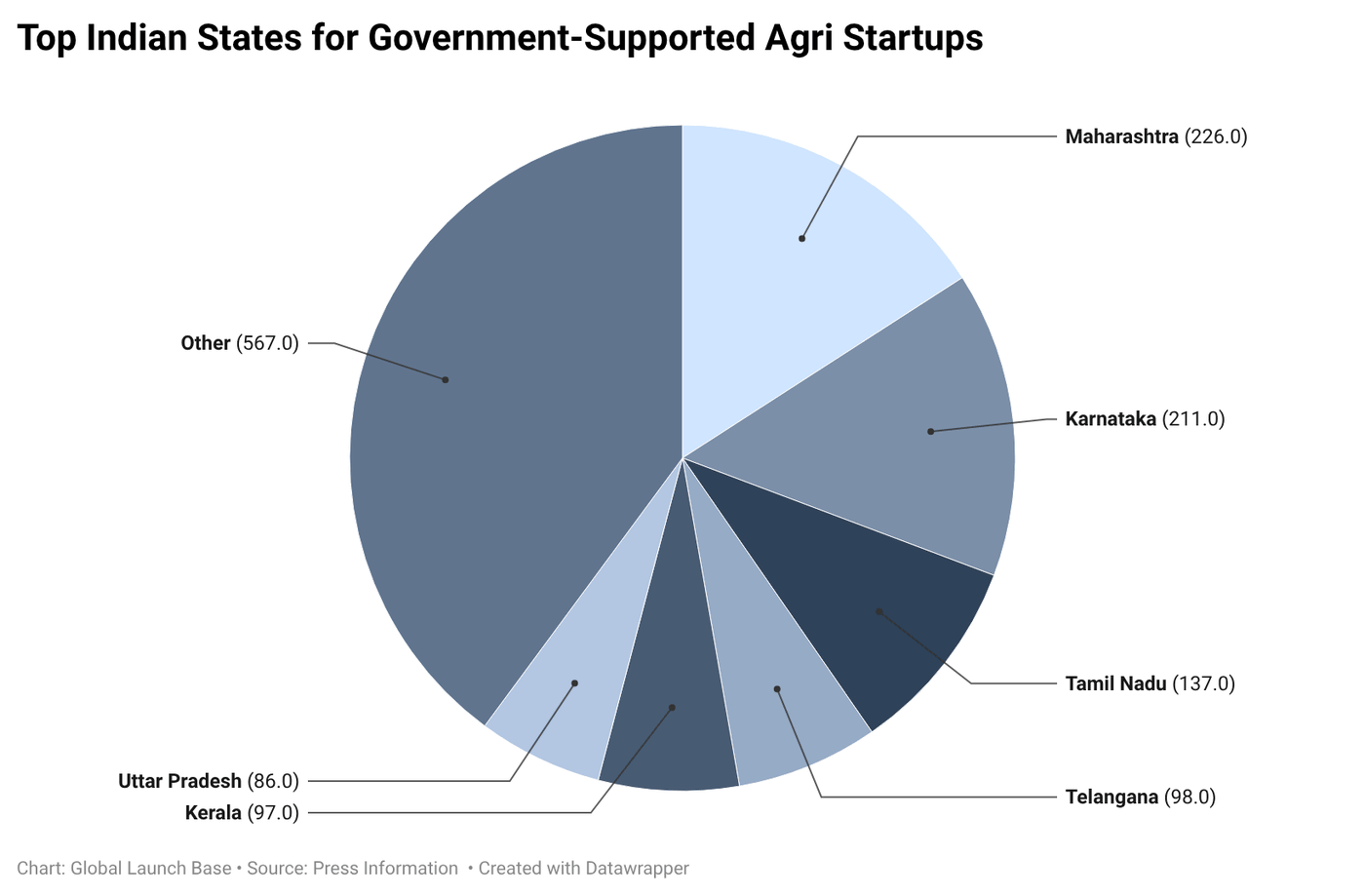
The opportunity is significant. Agriculture and allied activities employ around 46.1% of India's workforce, while the sector contributes nearly one-fifth of the country's economic output. India's agriculture and allied sector has also maintained an average annual growth rate of around 4.4% over the past five years.
For European startups that have already proven their technology at home, India offers something particularly valuable: scale, diversity and real-world complexity.
But entering India is not simply about selling a European product to Indian farmers. The startups most likely to succeed will be those that adapt their technology, pricing, partnerships and business model to the Indian agricultural ecosystem.
India Is No Longer Just a Large Agricultural Market
India's agricultural opportunity goes far beyond the number of farmers.
The country produced an estimated 357.73 million tonnes of foodgrains in 2024–25, while horticulture production reached more than 362 million tonnes. Horticulture alone has become a major contributor to agricultural value creation, accounting for approximately one-third of agricultural GVA according to the Economic Survey 2025–26.
At the same time, Indian agriculture is becoming increasingly digital.
The Government of India has approved a ₹2,817 crore Digital Agriculture Mission, built around infrastructure such as AgriStack, the Krishi Decision Support System and digital soil information.
By 2026, AgriStack is being positioned as foundational digital infrastructure connecting farmer identity, land records, crops and agricultural services. The Farmer Registry is also being integrated with areas such as agricultural credit, crop insurance, procurement and weather advisories.
This changes the opportunity for technology companies.
India is gradually building the digital infrastructure on which new agricultural services can operate.
Why This Is Attractive to European AgriTech Startups
European AgriTech has developed significant expertise in areas such as:
- Precision agriculture
- Farm automation
- Agricultural robotics
- Satellite and remote sensing
- AI-based crop monitoring
- Weather intelligence
- Water management
- Soil health
- Biological inputs
- Carbon and climate technologies
- Traceability
- Food supply-chain optimisation
- Alternative proteins and bio-based materials
Many of these technologies are highly relevant to India.
The difference is that India often presents the problem at a much larger and more varied scale.
A technology designed for a particular European crop, farm structure or climate can be challenged across India's very different agricultural environments—from coffee plantations in Karnataka to vineyards in Maharashtra, rice systems in Punjab, horticulture in Himachal Pradesh and smallholder farms across eastern India.
That makes India more than a sales market.
It can become a technology validation market.
Five Reasons European Startups Are Looking at India
1. The Scale of the Agricultural Economy
India has an enormous agricultural ecosystem.
Agriculture supports hundreds of millions of livelihoods directly and indirectly, and the country has a huge network of farmers, Farmer Producer Organisations (FPOs), cooperatives, processors, input companies, financial institutions and agri-businesses.
For a startup, this creates multiple potential customer groups.
The customer does not necessarily have to be the farmer.
A European AgriTech company could sell through:
Startup → FPO → Farmers
or
Startup → Agribusiness → Farmers
or
Startup → Bank/Insurer → Farmers
or
Startup → Government/Institution → Agricultural ecosystem
This B2B2F model can often be more scalable than attempting to acquire individual farmers one by one.
2. India Is Building Digital Public Infrastructure for Agriculture
One of India's most interesting advantages is its growing digital infrastructure.
The Digital Agriculture Mission is creating systems around farmer registries, crop surveys, geospatial information and agricultural decision support. The government has targeted the creation of 11 crore Farmer IDs by 2026–27.
Digital Crop Surveys are also being developed to capture crop-sown information directly from agricultural plots.
For European technology companies working with data, AI, insurance, finance or advisory services, this emerging infrastructure could create new integration opportunities.
Instead of building every layer of agricultural data infrastructure independently, startups can increasingly build solutions that connect to a wider ecosystem.
That could make India particularly attractive for:
- Weather intelligence platforms
- AI crop advisory
- Remote sensing
- Agricultural insurance technology
- Credit scoring
- Farm monitoring
- Supply-chain traceability
- Digital farm management
3. India's Agricultural Problems Are Exactly Where ClimateTech Is Needed
European AgriTech is increasingly connected to the broader ClimateTech movement.
India provides a huge real-world environment for climate solutions.
Farmers face challenges involving:
- Increasing weather variability
- Water availability
- Heat stress
- Pest and disease outbreaks
- Input costs
- Soil degradation
- Irrigation efficiency
- Crop losses
- Supply-chain inefficiencies
This creates demand for technologies that can help farmers anticipate risk rather than simply react to it.
For example, a European startup developing weather intelligence may be able to combine weather data, satellite imagery and crop information to create highly localised advisories.
A European irrigation technology company could focus on reducing water consumption.
A biological-input company could work with Indian crops and local agronomy partners.
A carbon-tech company could develop measurement and verification models around agricultural residues, biochar or regenerative practices.
The opportunity is therefore not simply "AgriTech in India."
It is ClimateTech applied to one of the world's largest agricultural systems.
4. India Is Becoming a Test Market for AI in Agriculture
AI is one of the most interesting areas of convergence between European technology and Indian agricultural needs.
India offers enormous amounts of agricultural variability: different crops, climates, soil conditions, farm sizes and production systems.
That creates a valuable environment for testing whether an AI system can perform outside controlled conditions.
Recent developments already demonstrate India's potential as a development environment. Google has developed agricultural AI models in India that use satellite imagery to understand agricultural landscapes and detect farming-related events, with applications now extending beyond India to other countries.
The lesson for European startups is important:
India can be a place to localise technology—and potentially improve it for global markets.
A system that works across India's complex agricultural conditions may become more adaptable elsewhere.
5. India Has a Growing AgriTech Startup Ecosystem
European startups do not have to enter an empty market.
India already has a growing ecosystem of AgriTech entrepreneurs, incubators, agribusinesses and technology providers.
The Government of India's Innovation and Agri-Entrepreneurship Development programme under RKVY supports agricultural startups and incubation. The government has appointed six Knowledge Partners and 24 RKVY Agribusiness Incubators to support startup development.
This creates an increasingly important opportunity for European companies:
Instead of competing with India's ecosystem, partner with it.
An Indian startup may already understand the farmer segment, distribution model and local regulatory environment.
A European startup may bring the technology, IP and international experience.
Together, they can potentially create a stronger market proposition than either company could build alone.
The Biggest Mistake: Treating India as One Market
India is not one agricultural market.
This is perhaps the most important lesson for European startups.
A technology that works for a large mechanised farm in Europe may not work for a two-hectare Indian farm.
Similarly, a product designed for wheat or maize may have little relevance to a coffee, pepper, arecanut or horticulture ecosystem.
India needs market segmentation before market entry.
A startup should ask:
- Which crop?
- Which state?
- Which farmer segment?
- What is the average farm size?
- Who actually pays?
- What problem has an economic value?
- Who influences the farmer's purchasing decision?
- Which local organisation can distribute the technology?
- What level of localisation is required?
For example, a European weather-intelligence startup might find very different opportunities in Karnataka's coffee belt, Maharashtra's horticulture sector and Punjab's cereal production systems.
The technology may remain the same.
The commercial model cannot.
The European Technology + Indian Distribution Model
One of the strongest models for European AgriTech companies could be:
European Technology
- Indian Market Knowledge
- Local Distribution
- Pilot Validation
=
Scalable India Entry
Instead of establishing a large Indian operation immediately, startups can begin with a carefully selected pilot.
For example:
Step 1 — Identify a specific agricultural problem
Rather than entering with "AI for agriculture," focus on a measurable problem such as irrigation efficiency, pest prediction or weather-risk management.
Step 2 — Find the right ecosystem partner
This could be an FPO, agribusiness, university, research organisation, startup, cooperative or agricultural institution.
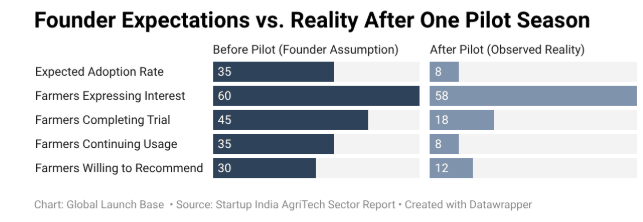
Step 3 — Run a controlled pilot
Measure outcomes such as:
- Yield
- Input savings
- Water savings
- Labour savings
- Crop-loss reduction
- Farmer adoption
- Revenue improvement
Step 4 — Localise the product
Adapt language, pricing, crop models, advisory formats, integrations and user experience.
Step 5 — Build the commercial model
Only after proving value should the company decide whether to pursue direct sales, partnerships, licensing, B2B2F or a joint venture.
What European Startups Need to Adapt
Technology alone is rarely enough.
Pricing
European pricing models often need significant adjustment for the Indian market.
A subscription that is affordable for a European commercial farm may be difficult for an individual Indian farmer.
This is where institutional buyers, FPOs and agribusinesses become important.
Language
Agricultural technology may need to work in local languages—not simply English.
For many use cases, voice and WhatsApp-based interfaces can also be more practical than complex standalone applications.
Hardware
Hardware needs to withstand different environmental conditions while remaining affordable and serviceable.
Distribution
The question is not only "How do we sell?"
It is:
Who already has the farmer's trust?
Proof of ROI
Indian customers can be highly value-conscious.
A startup should be prepared to demonstrate a measurable economic outcome.
"AI-powered" is not a business case.
"Reduced irrigation costs by X%" is.
Where the Biggest Opportunities Could Be
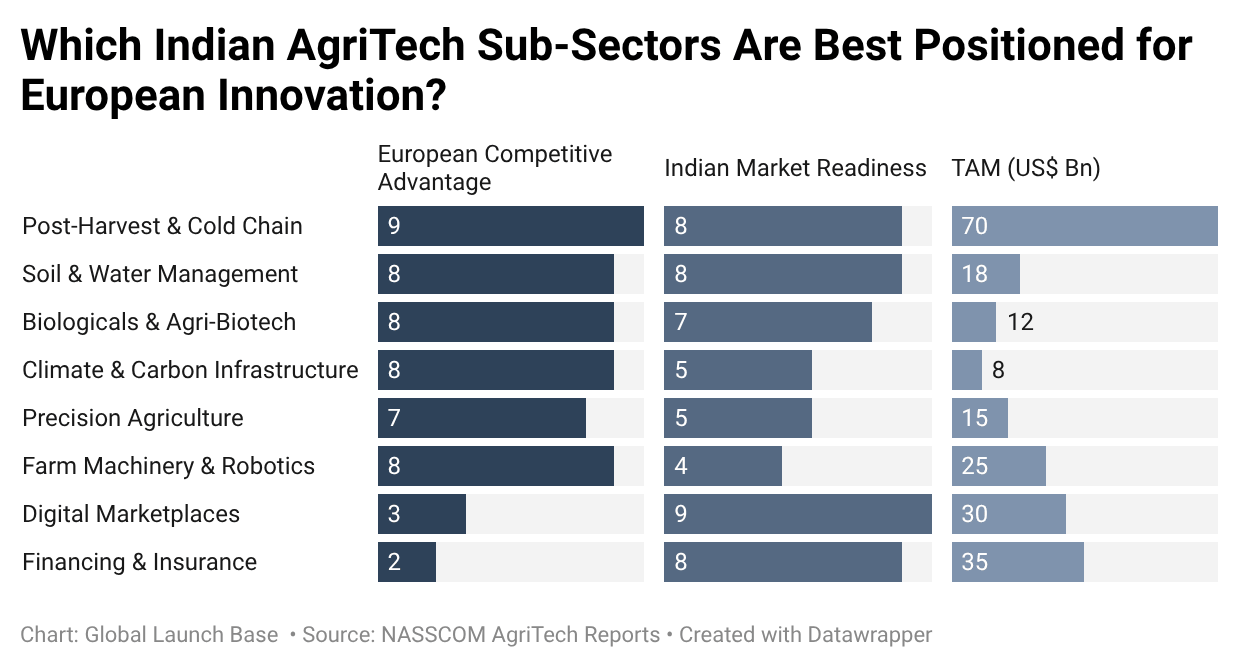
The next wave of European–Indian AgriTech partnerships is likely to emerge around several areas.
| Opportunity | Why India Matters |
|---|---|
| Weather Intelligence | Weather variability creates demand for localised forecasting and advisories |
| AI & Remote Sensing | Large agricultural landscapes create opportunities for satellite-based monitoring |
| Precision Irrigation | Water efficiency is increasingly important |
| Climate-Smart Agriculture | Farmers need technologies that reduce climate-related risks |
| Biological Inputs | Demand for sustainable alternatives creates opportunities for biological solutions |
| Farm Automation | Labour availability and rising costs create demand for mechanisation |
| Carbon & Biochar | Agricultural residues and climate finance create emerging opportunities |
| Supply-Chain Technology | Large and fragmented value chains create traceability and efficiency challenges |
| Agri-FinTech | Digital farmer infrastructure can support new financial products |
| Post-Harvest Technology | Food losses and expanding horticulture create opportunities for storage and processing technologies |
India's e-NAM ecosystem also demonstrates the scale at which digital agricultural marketplaces can operate. By July 2025, more than 1.79 crore farmers and 4,518 FPOs were registered on the platform.
India Is Also a Learning Market for Europe
There is another reason European startups should look at India.
The learning does not have to move only in one direction.
India can force technology companies to solve problems around:
- Low-cost deployment
- Distributed infrastructure
- Multilingual interfaces
- Smallholder economics
- Offline connectivity
- High-volume data
- Diverse climatic conditions
- Flexible business models
Those capabilities can subsequently become valuable in Africa, Southeast Asia, Latin America and other emerging agricultural markets.
In that sense, India can become a launchpad for emerging-market expansion.
A startup that learns how to commercialise successfully in India may be better prepared to enter several other high-growth agricultural markets.
The Future Is Not "Europe vs India"
The most interesting opportunity is not European technology replacing Indian technology.
It is European innovation combining with Indian scale and market knowledge.
European startups bring strengths in scientific research, engineering, sustainability, regulation and technology development.
India brings scale, agricultural diversity, entrepreneurial ecosystems, digital infrastructure and a huge network of farmers and agricultural businesses.
The combination can create something more powerful than either side working independently.
What European AgriTech Founders Should Do Next
For a European startup considering India, the first question should not be:
"How big is the Indian market?"
The better questions are:
- Which Indian agricultural problem does our technology solve?
- Which crop and geography have the strongest need?
- Who is the economic buyer?
- Which Indian organisation already has access to those customers?
- What needs to be localised?
- Can we prove ROI through a 3–6 month pilot?
- Can the Indian deployment become a reference case for other emerging markets?
This changes the India strategy from "entering a new country" to building a repeatable internationalisation model.
India's Opportunity for European AgriTech
India is becoming increasingly difficult for global AgriTech companies to ignore.
The combination of a massive agricultural economy, digital public infrastructure, climate challenges, expanding technology adoption and a growing startup ecosystem creates a rare environment for innovation.
The opportunity is particularly attractive for European startups because India does not simply offer customers.
It offers scale, experimentation, partnerships, data, market learning and a pathway into other emerging economies.
The winners, however, will not necessarily be the companies with the most advanced technology.
They will be the companies that understand how to translate technology into local economic value.
For European AgriTech founders, that is the real India opportunity.
Don't enter India just to sell. Enter India to validate, adapt, partner and scale.