Why Weather Intelligence Is Becoming Critical Infrastructure for Indian Agriculture
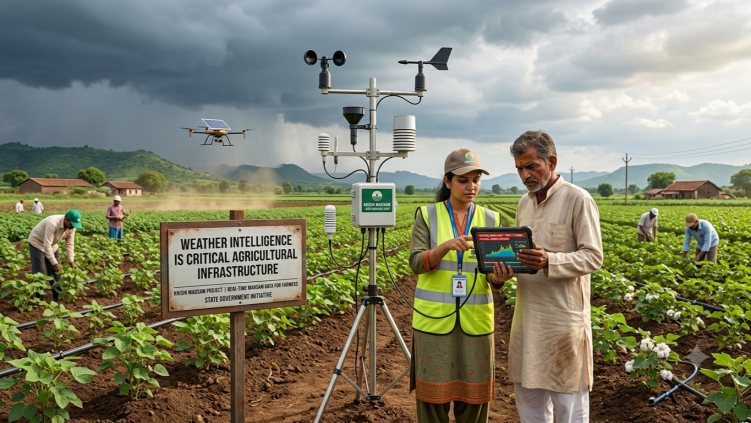
For decades, weather information in Indian agriculture was treated as useful advice: a forecast before sowing, a rain warning before harvesting, or a seasonal outlook before the monsoon.
That is changing.
As rainfall becomes more variable, temperatures rise and extreme events become harder to manage, weather intelligence is moving from the category of “helpful information” to something much closer to critical agricultural infrastructure.
The reason is simple: almost every major farm decision is, directly or indirectly, a weather decision.
When to sow. When to irrigate. Whether to spray. When to apply fertilizer. Whether to harvest. How to protect a crop from heat, heavy rain or frost. Whether a disease outbreak is likely. Whether water should be stored or released.
Better weather intelligence can turn these decisions from reactive guesses into informed actions.
India’s agriculture is increasingly exposed to weather risk
Indian agriculture already operates under significant climatic uncertainty. The India Meteorological Department (IMD) describes Indian agriculture as predominantly weather dependent, with temperature, rainfall, humidity, wind and extreme events such as heat waves, heavy rainfall, dry spells and frost having significant effects on crop growth, productivity and farm income.
The broader climate picture is also changing.
According to IMD, 2025 was India's eighth-warmest year since nationwide records began in 1901, with the annual mean land-surface temperature 0.28°C above the 1991–2020 average. The previous year, 2024, remains the warmest year on record, at 0.65°C above the long-term average.
Importantly, climate risk is not simply about getting hotter.
Rainfall can become more difficult to manage when a season combines dry periods with intense rainfall events. A farmer does not benefit from “normal rainfall” if much of that rain arrives at the wrong time, in the wrong intensity, or when the crop cannot absorb it.
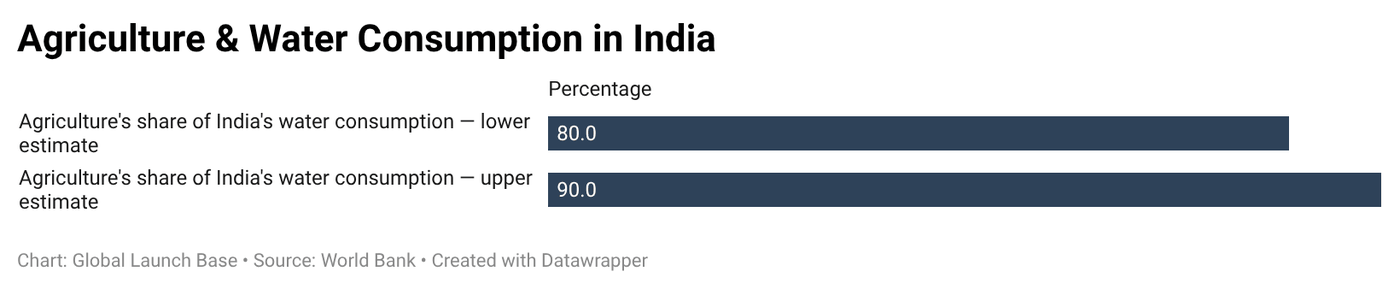
India's water cycle makes this particularly important. Nearly 70% of the country's annual rainfall occurs in just three months, while agriculture consumes roughly 80–90% of India's water.
This creates a narrow window in which weather and water decisions have enormous economic consequences.
Why Weather Intelligence Is Becoming Critical Infrastructure for Indian Agriculture
Weather affects almost every farm decision
Consider a typical crop cycle.
| Farm decision | Weather intelligence can help answer |
|---|---|
| Sowing | Is the soil likely to receive sufficient rainfall after sowing? |
| Irrigation | Will rainfall arrive soon enough to avoid unnecessary irrigation? |
| Fertilizer | Is rain likely to wash away nutrients after application? |
| Spraying | Will rain or strong winds reduce the effectiveness of a spray? |
| Pest management | Are temperature and humidity conditions favourable for disease development? |
| Harvesting | Is there a sufficiently dry window for harvesting and drying? |
| Post-harvest | Can produce be safely dried or stored without moisture-related losses? |
| Extreme-weather protection | Is there enough warning to protect crops, livestock and infrastructure? |
This is why a weather forecast alone is not enough.
A farmer doesn't really need to know that 30 mm of rain is expected.
They need to know:
“What does 30 mm of rain mean for my crop, and what should I do today?”
That is the difference between weather data and weather intelligence.
From forecast to decision support
The next generation of agricultural weather services is therefore moving towards an impact-based approach.
IMD's KALP initiative uses a Forecast–Impact–Action framework. Instead of simply communicating weather conditions, the system combines location-specific forecasts with crop phenology and crop sensitivity to determine the likely impact and recommended action.
For example:
Forecast: Heavy rainfall expected in the next 48 hours.
Impact: Waterlogging risk is high for a particular vegetable crop.
Action: Delay irrigation, improve drainage and postpone fertilizer application.
This sounds simple, but it represents a fundamental shift in agricultural technology.
The value is no longer in delivering more weather information.
The value is in converting weather information into a decision at the right time.
The evidence is already emerging
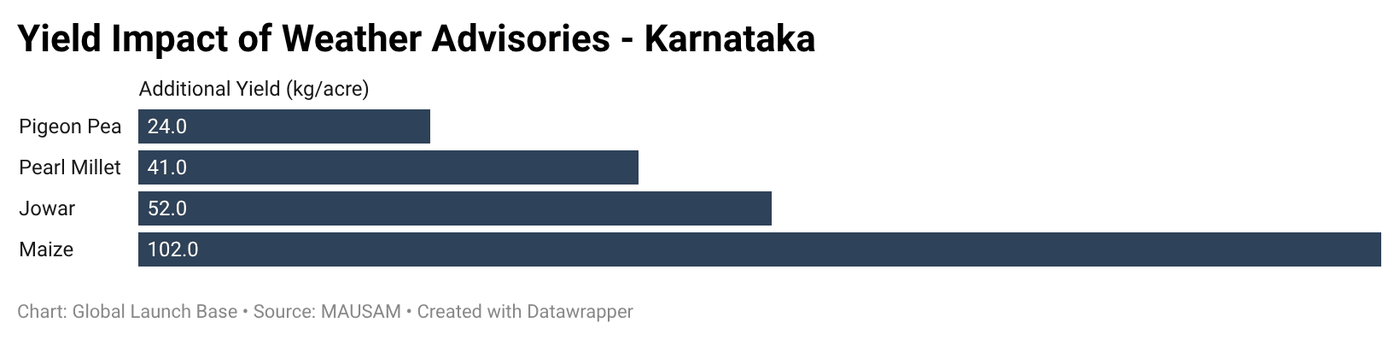
Research from Karnataka provides an important indication of the economic value of agricultural weather advisories.
A 2025 study published in MAUSAM evaluated agrometeorological advisory services in four rainfed districts of northern Karnataka. Farmers who benefited from the advisories recorded higher yields than comparable non-beneficiaries: approximately 24 kg/acre more for pigeon pea, 41 kg/acre for pearl millet, 52 kg/acre for jowar and 102 kg/acre for maize. The researchers estimated potential economic gains of around ₹962 million across the four districts under their study assumptions.
The significance goes beyond the individual yield numbers.
It demonstrates that relatively low-cost information can influence physical agricultural outcomes.
In other words, information infrastructure can become productivity infrastructure.
India is already building the foundation
Weather intelligence is not starting from zero.
IMD has operated agricultural meteorology services for decades, with the objective of reducing the impact of adverse weather on crops and using favourable weather conditions to improve agricultural production. Its services include the Gramin Krishi Mausam Sewa, agrometeorological advisories and farmer-focused weather dissemination.
The scale is also expanding.
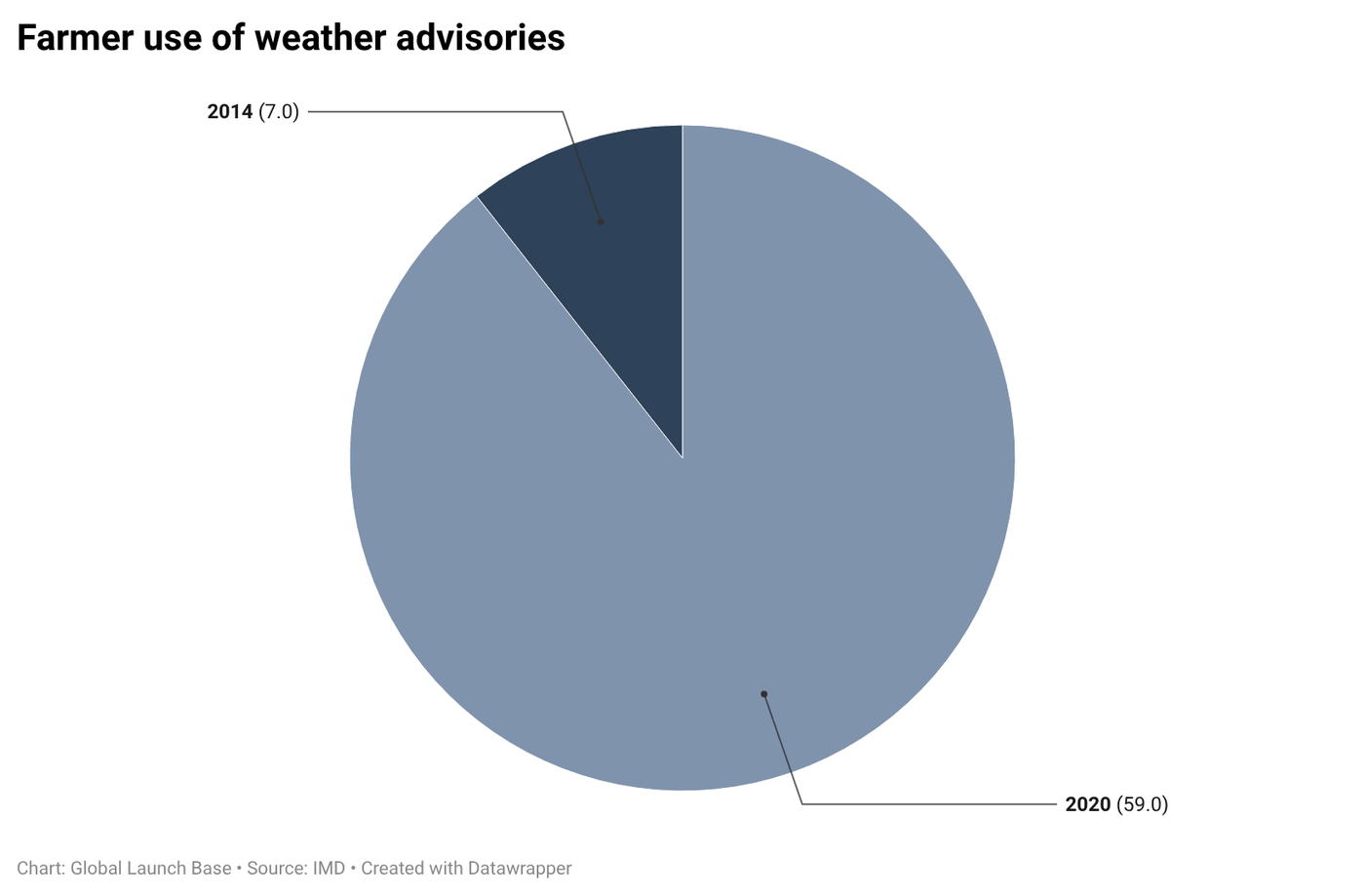
IMD's 2025 annual report stated that agrometeorological advisories distributed through SMS and IVR under the PPP mode were reaching approximately 6.09 million farmers. The department has also been integrating weather forecasts and advisories with state-government and academic platforms.
The current system includes district, state and national advisories, location-specific forecasts and initiatives such as KALP and SANKALP.
The next challenge is therefore not simply creating a national weather service.
It is making weather intelligence granular enough to support decisions at farm level.
The rise of hyperlocal weather intelligence
A village can have very different weather from a location 20–30 kilometres away.
This is particularly important in regions with complex terrain, such as the Western Ghats, where elevation, vegetation, rainfall patterns and microclimates can vary significantly.
A district-level forecast can therefore be useful for general planning but insufficient for precision agriculture.
This is where technologies such as:
- Automatic Weather Stations
- IoT sensors
- satellite data
- radar
- remote sensing
- soil-moisture monitoring
- machine learning
- crop models
- digital farm records
can work together.
IMD's own Vision 2047 document identifies expansion of Automatic Weather Stations and Automatic Rain Gauge networks, high-resolution forecasting and AI-based predictive models as important directions for improving agricultural weather services.
The future is not one weather station producing one forecast.
It is a network of observations feeding models that understand place + crop + growth stage + weather + risk.
Weather intelligence can also reduce water waste
One of the biggest opportunities is irrigation.
Farmers often irrigate based on routine, experience or visible soil conditions. But irrigation decisions can become considerably more precise when combined with rainfall forecasts, soil moisture and crop water requirements.
For example:
Without weather intelligence:
Irrigate → rain arrives → water is wasted.
With weather intelligence:
Rain forecast → irrigation delayed → rainfall supplies part of crop demand.
At scale, these small decisions matter.
India faces significant water stress, while agriculture remains the country's largest water-consuming sector. The World Bank notes that increasing flood and drought frequency is adding pressure to India's water systems.
Weather intelligence therefore sits at the intersection of farm productivity and water security.
It can also change how farmers manage crop protection
Weather is closely connected to pest and disease dynamics.
Temperature, humidity, rainfall and leaf-wetness conditions can influence the development and spread of many agricultural diseases.
That creates an opportunity for early-warning systems.
Instead of telling a farmer:
“A disease has appeared.”
A better system can potentially say:
“Weather conditions over the next five days create a high risk of disease development. Monitor these fields and consider preventive action.”
This approach can reduce unnecessary chemical applications while allowing farmers to respond earlier when intervention is justified.
For horticulture, plantation crops and high-value agriculture, where crop losses can be particularly expensive, this becomes even more valuable.
Weather intelligence is also becoming financial infrastructure
The implications extend beyond farming.
Weather information increasingly matters to banks, insurers, FPOs, agribusinesses and agricultural supply chains.
For insurers, better weather observations can improve risk assessment and claims verification.
For lenders, weather intelligence can contribute to understanding portfolio risk.
For FPOs, it can help coordinate farm-level advisories and procurement.
For food processors, it can improve expectations around crop availability.
For agribusinesses, it can help anticipate supply disruptions.
For governments, it can support early intervention during extreme weather.
This is why weather intelligence should not be viewed merely as another farmer-facing mobile application.
It can become a shared risk-management layer for the agricultural economy.
The real opportunity for AgriTech
The biggest opportunity is not to build another weather app.
India already has weather data and government forecasting infrastructure.
The opportunity is to build the intelligence layer between the forecast and the decision.
That could mean a platform that combines:
Weather forecast + farm location + crop + crop stage + soil + irrigation + historical conditions → recommended action
For example:
Coffee farm
Heavy rain expected → reduce irrigation → improve drainage → delay nutrient application → monitor fungal disease risk.
Arecanut farm
High humidity + prolonged rainfall → increase disease surveillance → inspect palms → adjust field management.
Vegetable farm
High-temperature period expected → modify irrigation timing → protect sensitive crops → adjust spraying schedule.
Rainfed maize farm
Delayed rainfall forecast → reconsider sowing window → conserve soil moisture → avoid premature input expenditure.
The technology becomes valuable when it answers the farmer's actual operational question.
The last-mile problem remains critical
Better forecasting does not automatically create better outcomes.
The information must reach the farmer in the right language, through the right channel and at the right time.
IMD has recognised this challenge. Its Vision 2047 identifies gaps in reaching farmers with real-time weather information and calls for multi-channel dissemination and regional-language access.
For many farmers, the most effective delivery mechanism may not be a sophisticated dashboard.
It could be:
- SMS
- voice messages
- local-language alerts
- FPO networks
- extension workers
- farmer groups
- village-level weather displays
The best weather intelligence is ultimately the intelligence that gets acted upon.
What critical infrastructure could look like
If weather intelligence becomes agricultural infrastructure, the system could develop into something like this:
| Layer | Infrastructure |
|---|---|
| Observation | Weather stations, rain gauges, satellites, radar, farm sensors |
| Forecasting | Numerical weather models and AI/ML |
| Interpretation | Crop models, soil data and crop-stage information |
| Risk assessment | Heat, drought, flood, disease and water-stress indicators |
| Advisory | Crop-specific recommendations |
| Distribution | Mobile, WhatsApp, SMS, IVR and FPO networks |
| Feedback | Farmer observations and field outcomes |
| Learning | Models continuously improved using local data |
This creates a feedback loop:
Observe → Forecast → Interpret → Advise → Act → Measure → Improve
That is much closer to infrastructure than a traditional weather bulletin.
What this means for European AgriTech companies
For European climate and AgriTech companies entering India, weather intelligence represents an important opportunity.
But localisation will be essential.
A forecasting model developed for European farms cannot simply be transplanted into India. Indian agriculture involves different crops, monsoon dynamics, farm sizes, irrigation systems, languages and microclimates.
The strongest solutions are likely to be those that combine global technology with Indian data, local agronomy and local distribution networks.
Partnerships with FPOs, agricultural universities, government agencies, weather-data providers and AgriTech platforms could therefore become important routes to scale.
The opportunity is not just selling technology to farmers.
It is building a system that makes existing agricultural infrastructure—irrigation, inputs, extension, insurance, finance and supply chains—more weather-aware.
From weather forecast to agricultural operating system
Indian agriculture has traditionally been built around physical infrastructure: roads, irrigation systems, warehouses, cold chains, markets and machinery.
The next layer will be digital.
And among digital infrastructure, weather intelligence may become one of the most important because weather touches almost every physical and financial decision on the farm.
The question is no longer whether farmers need weather information.
They clearly do.
The bigger question is whether India can build systems that transform increasingly complex weather data into simple, timely and economically useful decisions for millions of farms.
As climate variability increases, the farmer who knows what the weather will do is better positioned than the farmer who only knows what the weather is doing.
That is why weather intelligence is moving from information service to critical infrastructure for Indian agriculture.
Key takeaway
The future of agricultural weather intelligence is not better forecasts alone. It is better decisions.
The winning systems will connect hyperlocal weather data with crops, soil, farm operations and farmer behaviour—and deliver one clear answer:
“Given what is coming, what should I do now?”
That is the point at which weather intelligence stops being a forecast and starts becoming agricultural infrastructure.